

Introduction
Access to health services is an important focus for regional development, playing a key role in quality of life and the well-being of communities, which in turn influences social and economic growth. Access to quality health services is identified (alongside access to quality childcare and education) as a Strategic Outcome under the National Planning Framework (NPF). The NPF states that good access to services, relative to the scale, profile and needs of a population, is a ‘defining characteristic of attractive, successful and competitive places’.
Distance to health services is particularly relevant for more rural and peripheral areas, such as those in the Western Region, and influences ease of access to and availability of healthcare for communities and the different groups within them, such as older people and those with existing conditions. The Western Region has a higher old age dependency ratio (the ratio of people aged 65 and over to those of working age) of 26.9 compared to the State’s overall ratio of 23.1 (Census 2022), which should have implications for planning and provision of health services. Furthermore, while overall health in each county in the region is generally ‘very good’ or ‘good’ (Census 2022), the demographic profile of the Western Region is distinctive which, when combined with poorer access to public and other transport options, can influence health outcomes and quality of life overall.
The CSO has recently published a statistical release, ‘Measuring Distances to Services in Ireland 2026 – Health Services’, which presents the distribution of health services across multiple geographical levels. Given the variation in distribution of health services across the State and within the Western Region itself, this Insights article will consider the statistics presented in the release at county level, to understand the intra-regional context as well as the situation in the region in comparison to the overall national picture.
Understanding the data
The CSO’s statistical release considers distance to nine different health services across different spatial levels, which allows for comparison at national level, regional level and administrative county level.
It should be noted that ‘distance to services’ refers to the median distance to each health service discussed in this article. The CSO states that the median is used in their release because it provides a better indicator of typical access than the mean, which would present skewed results due to the large variation in the distribution of services in some areas. Further information on the mean distances to services and distances with regard to the 25th and 75th percentiles can also be found in the CSO data tables relating to this release.
Distance to health services in the Western Region
The types of service outlined in the Statistical Release which we will consider in relation to the Western Region are: Emergency Department, Injury Unit, Maternity Department, Primary Care Centre, General Practitioner (GP) and Pharmacy.
Emergency Departments
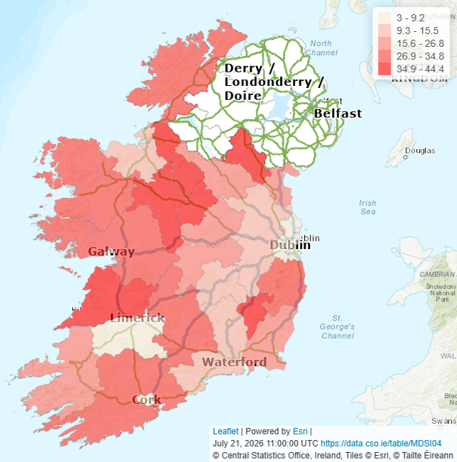
Figure 1: Median Distance (km) to the Nearest Emergency Department for Households by Administrative County, 2026.
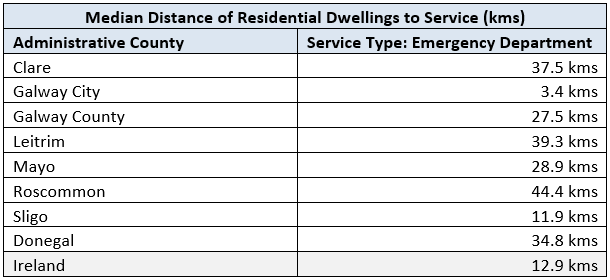
Table 1: WDC analysis of CSO data: Median Distance (km) to the Nearest Emergency Department for Households by Administrative County, 2026.
Households in Roscommon have the longest median distance to an Emergency Department in the State, at 44.4km. Three of the seven counties in the Western Region are in the highest distance category (34.9-44.4km) – they are Clare (37.5km), Leitrim (39.3km), and Roscommon. Donegal and Mayo have median distances of 34.8km and 28.9km, respectively. Galway County has a median distance of 27.5km, while Galway City has a median distance of 3.4kms. Sligo has a median distance of 11.9kms, placing it in the lower end of the scale, nationally and regionally. It is notable that, aside from those administrative counties which include cities (Dublin, Cork, Galway, Limerick, and Waterford) or are in proximity to Dublin (Dún Laoghaire Rathdown, Fingal and South Dublin), Sligo has the shortest median distance to an Emergency Department and is also below the national median distance (12.9kms).
Injury Units
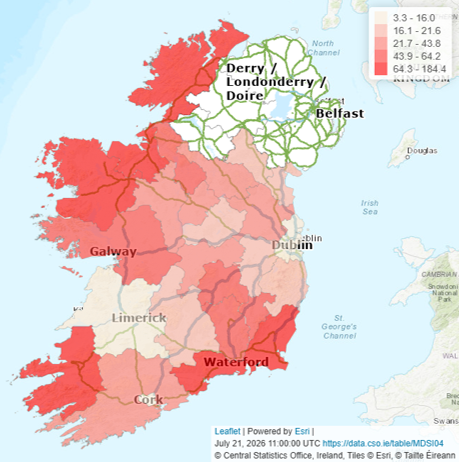
Figure 2: Median Distance (km) to the Nearest Injury Unit for Households by Administrative County, 2026.
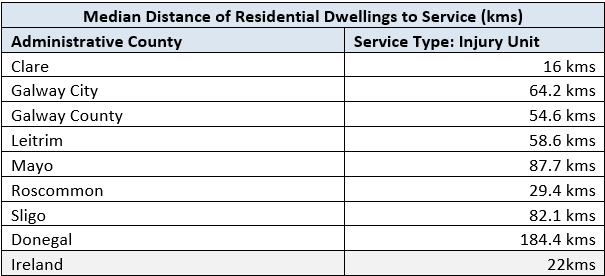
Table 2: WDC analysis of CSO data: Median Distance (km) to the Nearest Injury Unit for Households by Administrative County, 2026.
Households in Donegal have the longest median distance to an Injury Unit in the State by a significant margin, at 184.4kms. The county with the next furthest median distance is Wexford, at 93.6kms. Three Western Region counties are in the highest distance category (64.3 – 184.4kms) –those are Sligo (82.1kms), Mayo (87.7kms) and Donegal (184.4kms). Households in Galway City, Galway County and Leitrim are 64.2kms, 54.6kms and 58.6kms away from their nearest Injury Units, and households in Roscommon have a median distance of 29.4kms to their nearest Injury Unit. In the Western Region, only Clare (16kms) is below the national median distance of 22kms. The reason for such significant distances amongst Western Region counties is likely that some counties do not have Injury Units at all and their nearest Unit is in another county, which may be outside the region.
In those cases, there is often an Emergency Department in closer proximity. For example, in Sligo the median distance to an Emergency Department is 11.9kms and those services can provide the same services as Injury Units. However, for some counties the distance to both Emergency Departments and Injury Units is relatively high, such as Leitrim. Others, such as Clare and Roscommon, are close to an Injury Unit but not an Emergency Department. In both situations, households in these counties are further from services to address urgent and life-threatening conditions.
Maternity Departments
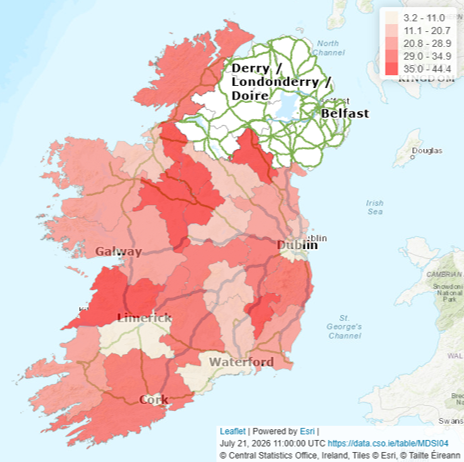
Figure 3: Median Distance (km) to the Nearest Maternity Department for Households by Administrative County, 2026.
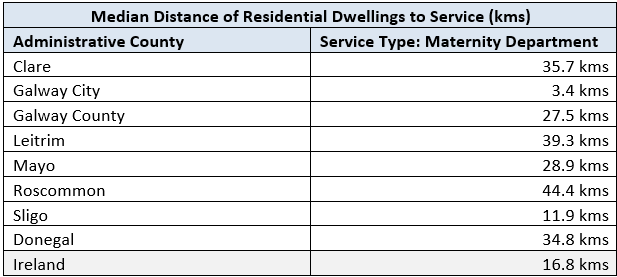
Table 3: WDC analysis of CSO data: Median Distance (km) to the Nearest Maternity Department for Households by Administrative County, 2026.
Households in Roscommon have the longest median distance to a Maternity Department in the State (tied with Monaghan), at 44.4kms. Leitrim has the second longest median distance in the State, at 39.3kms. Three counties in the Western Region fall within the highest distance category of 35-44.4kms for this service type – those are Clare (35.7kms), Leitrim, and Roscommon. Donegal, Mayo, and Galway County have median distances of 34.8kms, 28.9kms, and 27.5kms, respectively. Sligo has a median distance of 11.9kms, which is shorter than the national median distance of 16.8kms. Galway City has the second-shortest median distance in the State (3.4kms), and only Dublin City has a lower median distance to a Maternity Department (3.2kms).
Regarding Emergency Maternity Departments, the distance for all counties in the Western Region is the same as their distance to Maternity Departments. This may be due to the nearest Maternity Departments and Emergency Maternity Departments being in the same place for counties in the region, although this is not always the case throughout the country. Nationally, the median distance to an Emergency Maternity Department is 19.9kms.
Primary Care Centres
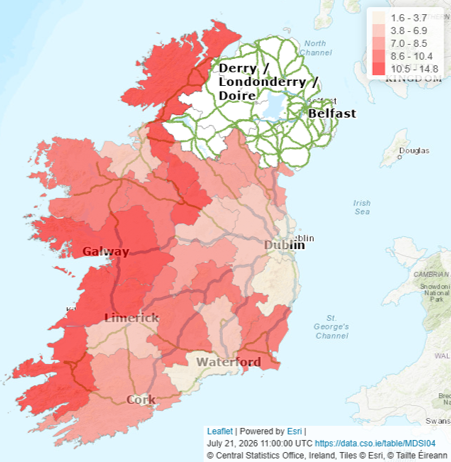
Figure 4: Median Distance (km) to the Nearest Emergency Primary Care Centre for Households by Administrative County, 2026.
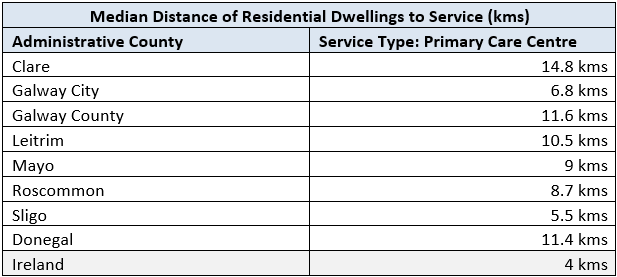
Table 4: WDC analysis of CSO data: Median Distance (km) to the Nearest Primary Care Centres for Households by Administrative County, 2026.
Households in Clare have the longest median distance to Primary Care Centres in the State, at 14.8kms. Households in Galway County (11.6kms) and Donegal (11.4kms) have some of the longest median distances to Primary Care centres nationally, with only Longford (13.1kms) and Kerry (12kms) having longer median distances. In the region, households in Leitrim, Mayo and Roscommon are 10.5kms, 9kms, and 8.7kms away from their nearest Primary Care Centre. Galway City (6.8kms) and Sligo (5.5kms) have the shortest median distances to Primary Care Centres in the region, but it is notable that this is still further than the national median distance of 4kms.
General Practitioners (GP)
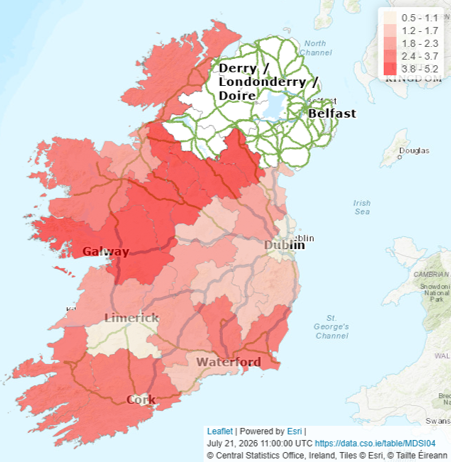
Figure 5: Median Distance (km) to the Nearest General Practitioners (GP) for Households by Administrative County, 2026.
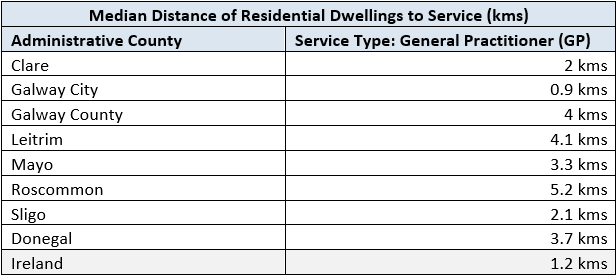
Table 5: WDC analysis of CSO data: Median Distance (km) to the Nearest General Practitioners (GP) for Households by Administrative County, 2026.
Households in Roscommon have the longest median distance to a General Practitioner (GP) in the State, at 5.3kms. Leitrim (4.1kms) and Galway County (4kms) have the third and fourth longest median distances in the State, behind only Monaghan (4.4kms). It is notable that several of the counties with the longest distance to their nearest GPs are clustered in the same part of the country (as shown in the map above, Figure 5), including counties outside the Western Region, such as Cavan (3.9kms) and Longford (3.9kms).
For other counties in the Western Region, households are quite far from their nearest GPs, relative to the national picture – Donegal, Mayo, Sligo and Clare have median distances of 3.7kms, 3.3kms, 2.1kms and 2kms, respectively. Only Galway City (0.9kms) has a distance shorter than the national median distance of 1.2kms.
Pharmacies
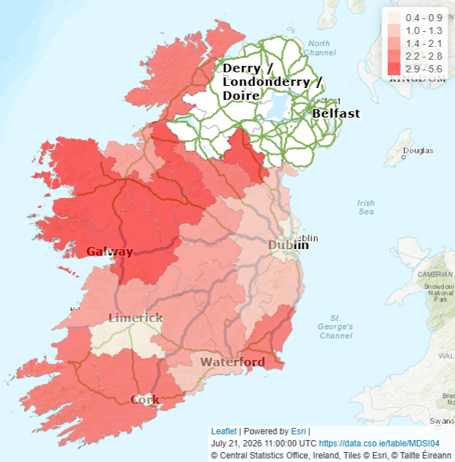
Figure 6: Median Distance (km) to the Nearest Pharmacy for Households by Administrative County, 2026.
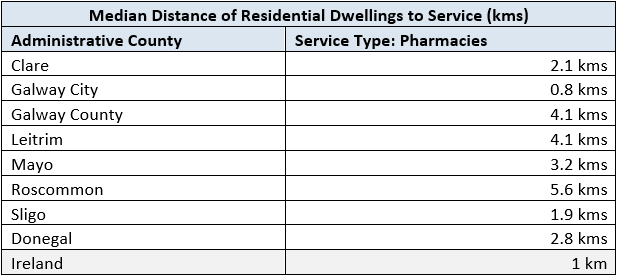
Table 6: WDC analysis of CSO data: Median Distance (km) to the Nearest Pharmacy for Households by Administrative County, 2026
Households in Roscommon have the longest median distance to their nearest Pharmacy in the State, at 5.6kms – a significantly longer distance than other counties, regionally and nationally. Leitrim (4.1kms), Galway County (4.1kms) and Mayo (3.2kms) have the second, third- and fifth-longest median distances to their nearest Pharmacy in the State. Households in Donegal, Clare, and Sligo have median distances of 2.8kms, 2.1kms, and 1.9kms to their nearest Pharmacy, respectively. Again, only Galway City (0.8kms) has distance shorter than the national median distance of 1km.
Conclusion – Reviewing distance to health services in the Western Region
As we can see from the data and related maps, there are variations in the median distance of households to different types of health services for each of the administrative counties in the Western Region. This is to be expected, but the data provides some interesting insights into the geographic distribution of health services.
Looking first to distance to health services within the region, while some counties hold the furthest distance to several types of health services, this is not uniform. There are some variations between which county has the furthest median distance, depending on which service type is being analysed. For example, Roscommon has the furthest median distance to an Emergency Department, Maternity Department (and Emergency Maternity Department), GP, and Pharmacy, but Donegal has the furthest median distance to an Injury Unit and Clare has the furthest median distance to a Primary Care Centre. In contrast, households in Roscommon and Clare are relatively close to their nearest Injury Units compared to other counties in the region, while households in Donegal are relatively close to their nearest Pharmacy compared to other counties in the region. Galway City is the only administrative area in the region in which households are consistently closest to health services (except for Injury Units). Given that Galway City represents the only city in the Western Region, is mostly urban, and has a small size of 53.4km², it is not surprising that households are within a short distance to those health services which are located there.
The variation in distance to different services across different counties is likely due to the way in which health services are distributed throughout each HSE Health Region and because of the population density and scale of settlements within each. All counties in the Western Region fall under the HSE West and North West Region (Donegal, Leitrim, Sligo, Roscommon, Mayo and Galway) and the HSE Mid West Region (Clare). Not all counties in the Western Region have each type of service located within them and, from analysis of the data, it appears that households in some counties will rely on health services in other counties to access their nearest location for a specific service, such as Maternity Departments. In addition, households in the north west may make greater use of cross-border health services provided by the likes of Altnagelvin Hospital, Derry/Londonderry or South West Acute Hospital, Enniskillen, which is not represented in this data.
Comparing distance to health services with the national context, it is a stark finding that a Western Region County had the furthest median distance in the State across each service type included in the Statistical Release. Some of those furthest distances were also significantly higher than the next-furthest median distance to a service. In addition, Western Region counties accounted for several of those in the highest distance category across almost all service types. The only exception to this is Galway City, which consistently came under the national median distance for health service types, and which aligned with trends in other city-only administrative areas, such as Dublin and Cork.
While, again, not a uniform picture, analysis of the information provided in the Release highlights that households often have a longer distance to access health services in the Western Region than in other parts of the State. As mentioned, access to health services is relevant to the predominantly rural Western Region. Although it is, understandably, challenging for Governments and relevant Departments to ensure that rural and remote communities have the same access to health services as more densely populated urban areas, extended distances to health services can delay or limit diagnosis and treatment for urgent and non-urgent conditions. It should be noted that proximity to health services does not necessarily speak to overall access to or quality of that service, but longer distances to services may present an additional barrier to accessing health care, particularly for those reliant on public transport. Furthermore, proximity to health services (and other services) plays a key role in the attractiveness of a region and may be one of the factors which influences decision-making around relocation to a particular place.
Health inequalities have a longer-term effect on the well-being of communities, on social and economic growth, and on regional development overall (Mseke et al, 2024). The data reviewed in this article suggests that a more effective distribution of health services, as well as increased use of community-based services and wider use of telehealth, is required to address some of these long distances to services in the Western Region and to support greater health equity across the country.
Notes:
All maps shown in Figures 1-6 are sourced from CSO Statistical Release ‘Measuring Distance to Services in Ireland 2026 – Health Services’, Region.
All tables included in this article are WDC analysis of CSO data, which can be found here.