

Introduction
The Western Development Commission (WDC) welcomes the publication of the National Development Plan (NDP) Review 2025 Sectoral Investment Plan for Transport. The Plan provides further detail around key transport investments across the west and the north west under the NDP Review 2026-2035.
The Plan states that ‘balanced investment across all regions and modes of transport is essential’, which aligns with commitments set out in the NDP Review 2025 and National Planning Framework (NPF). Citing the importance of evenly distributing population growth to promote regional parity, the Plan notes that greater transport connectivity can improve accessibility, make areas attractive to residents and businesses, and support balanced regional development. WDC analysis of travel to work patterns and labour catchment areas found that travel distances are an important determinant of commuting patterns and the mode of transport used. The same report found that the number of people living and working in the Western Region increased by 13.3% between 2016 and 2022, which has important implications for policy development and investment in transport infrastructure across the region.
In this Insights article, I consider the projects and commitments included in the Sectoral Investment Plan, and what it means for transport connectivity and sustainable mobility in the Western Region.
Rail
The Plan references the All-Island Strategic Rail Review (AISRR) as setting out a vision for the future development of the inter-city and inter-regional rail network. The inclusion of the Western Rail Corridor in the Plan was a recommendation of the AISRR, included in the previous NDP, and called for by regional organisations, businesses and communities in the west. The Western Rail Corridor link Athenry to Claremorris project (estimated at a cost range of €500m-€1bn) represents an important milestone for transport connectivity within and to the Region, and commencement of construction on the line is expected by 2028. While not currently included in the Plan, a recent Joint Oireachtas Committee on Transport meeting noted that further extension of the line to Collooney could be viable in future, which would also be positive for progressing rail connectivity across the region. While we welcome the significant proposed infrastructural investment, the levels and timings of services on this reopened line are what will ultimately determine its impact on connectivity and the regional economy.
The Plan refers to other interventions to assist train journeys on existing lines, including the Galway/Ennis line, the Sligo line, and the Westport/Ballina line, but there is currently little detail on any proposed improvements to these lines. All improvements to line infrastructure and services are welcome, particularly on key commuter routes within and to the region. The WDC has advocated for the prioritisation of the electrification and double-tracking of the Sligo-Dublin, Galway-Dublin, and Westport/Ballina-Dublin lines, which would significantly support greater regional connectivity and high-value employment in the Western Region and should be considered for future investment. Likewise, levels of service are important – for example, improved early morning access to Sligo would provide an alternative commuting option for along the line (from Carrick on Shannon onward). Currently, the earliest arrival of a train to Sligo is 10:16am.
Public Transport
Regarding areas of public transport aside from rail, the Plan sets out the intention to support regional and rural connectivity, including the expansion of rural mobility services. The Plan notes ongoing implementation of the Connecting Ireland Rural Mobility Plan and investment in rural bus infrastructure as part of this. Public transport services are crucial for connecting urban and rural communities in the Western Region, providing services which enable access to employment and education and support social inclusion and community cohesion. Connecting Ireland has already had a significant impact and certain routes show a high level of usage, indicating a previously unrealised demand. The provision of bus services and the way in which routes are designed and delivered also matters for rural and regional communities and we look forward to future developments in this area. The NDP is a capital investment programme, but it is important that capital investments are aligned with other elements of service provision. This includes timetabling and that efforts to ensure skills (for example for drivers) are also enhanced. In terms of capital investment, our Sustainable Mobility Index 2024 found that only four of the towns included scored highly in relation to access to services and social facilities like hospitals and provision of bus stop facilities for people with disabilities. This should be a priority for investment in future. Therefore, we would encourage the development of bus infrastructure and services which provide comprehensive and connected journey options within and to the region.
Bus Connects Galway has been announced in the Plan as part of bus services across the five cities, which is a step forward for sustainable mobility and connectivity within Galway. A relatively wide timeframe of 2026-2030+ is provided for delivery, and more specific information on the process will be welcome when it is available.
Roads
The Plan provides updates on a range of ongoing, new and indicative roads projects, many of which are priorities for supporting connectivity to and from the Western Region. Of the 44 new and indicative road projects included in the Plan, 11 are located in the Western Region, and represent an estimated cost range of €2.5-€4bn for those projects intended to commence by 2030 (of a total indicative allocation of €9.7bn for roads projects during this period).
There is considerable variation regarding timelines and current stages of project lifecycle across the noted projects in the region. For example, the Athenry Relief Road Section 3 and 5 and 263 Fintra Bridge and Road Realignment are under construction, and both are expected to be completed by 2026. The N5 Ballaghaderreen to Scramoge is also under construction and is expected to be completed by 2027. The Eastern Garavoge Bridge and Approach Roads in Sligo and Donegal TEN-T project (at pre-tender approval) are intended to commence by 2026 and 2028, respectively, and these developments will enhance strategic regional road networks in the region.
The inclusion of upgrades to the N17 Knock to Collooney in the Plan is significant as it is a main road artery through the region and is a long-standing investment priority for the WDC and other regional actors. However, the Plan states that construction is not expected to commence until after 2030, and it is currently at the first stages of approval (AG1). Further detail on this project will be important for assessing the positive impact that upgrades to the N17 will have for the region, and it will be important that progress continues and that opportunities to bring forward timelines, where feasible, are explored. Similarly, projects indicated for future construction, such as the N15 Sligo to county boundaries, N59 Clifden to Maam Cross, and Shannon Airport Road are currently not yet approved in principle (pre-AG1), and additional details and timelines should be provided as soon as they pass the first Approval Gate. Further detailed information on each project, particularly those which are new and indicative, would also be welcome when it becomes available.
We also welcome the commitments to the Carrick on Shannon Bypass, and to the much-needed improvements on the N4 between Mullingar and Longford. Improvements to this section should have significant benefits for the N4 (to Carrick on Shannon and Sligo, both of which have been designated as key towns or growth centres in the NPF and Regional Economic Spatial Strategy (RSES)) and into the west (Westport, Castlebar and Ballina, which has also been designated a key town).
A table with overview of each road project in the west and north west, as stated in the Plan, is included below:
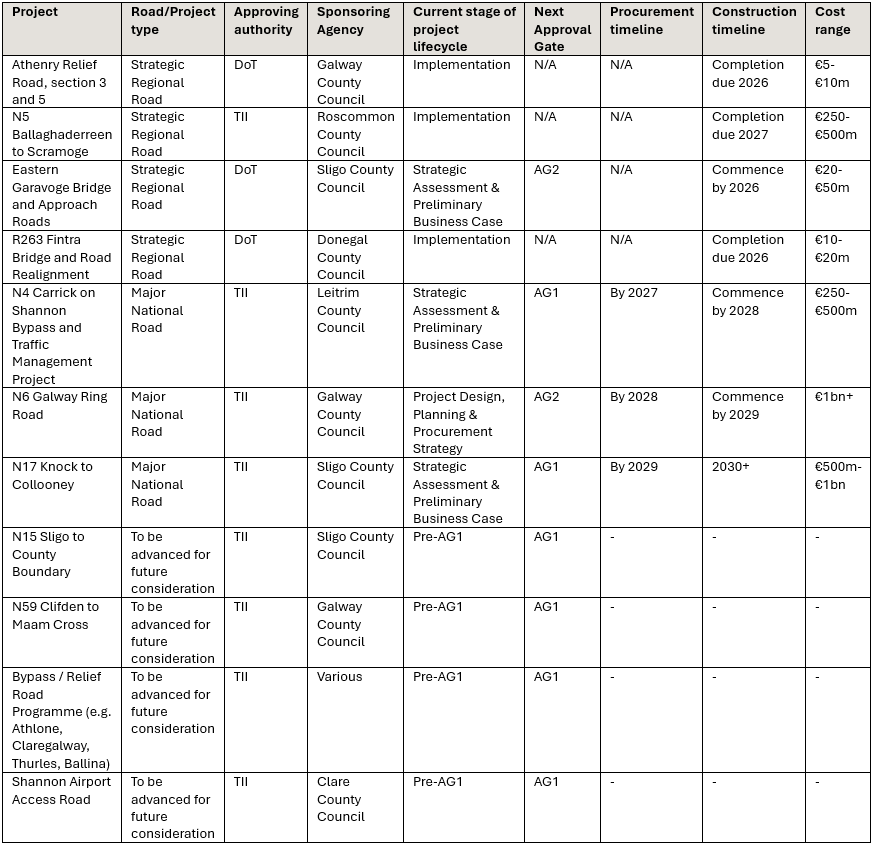
DoT = Department of Transport
TII = Transport Infrastructure Ireland
AG1 = Approval Gate 1 – Approval in principle
AG2 = Approval Gate 2 – Pre-tender approval
Reference in the Plan to investment in advanced traffic management systems and intelligent transport systems is important from a road safety perspective. The Road Safety Authority reported that, as of July 2025, road fatalities in the region accounted for 36% of the national total, with counties Galway (10), Donegal (9) and Mayo (8) representing three of the four counties with the highest number of road fatalities. Given that the Western Region makes up just 16.7% of the population of the State, this figure is stark. The same report stated that 36% of fatalities had occurred on national roads and a further 35% had occurred on regional roads as of July. While relevant nationally as well as regionally, the Western Region has a high proportion of regional and national roads, and the quality and capacity of road networks play an important role in assisting road safety as well as supporting connectivity and regional development.
Airports
The Plan includes reference to the development of the Regional Airports Programme (RAP) 2026-2030, which provides critical funding to regional airports for safety and security related projects, development projects, and sustainability initiatives. The Plan recognises that regional airports contribute to the local economy and that government policy on airports seeks to optimise conditions for connectivity and regional development. The three airports in the Western Region – Donegal Airport, Ireland West Airport Knock, and Shannon Airport – operate at different scales and in different catchments, and each is important for the regional economy and for providing regional connectivity. The Plan also refers to ongoing engagement with individual airports around specific project proposals, which is positive. The new RAP 2026-2030 should ensure that regional aviation infrastructure is supported to enable continued economic growth and connectivity for those living in the Western Region, and further detail will be welcome when it is published.
Conclusion
Investment in transport infrastructure is critical to supporting performance of the economy, economic growth, and population growth in the Western Region. The publication of the NDP Sectoral Investment Plan for Transport is very welcome and provides an update on transport infrastructure projects to be included in the NDP, following the initial announcement of Departmental and Sectoral funding allocations in July. The NDP and NPF set out an ambition to ensure a level of growth in the west and north west (combined with the Southern Region), to match the projected growth of the Eastern and Midlands Region. This can be realised through proportionally allocated funding, prioritisation of key infrastructure, and the delivery of regional projects throughout the lifespan of the new NDP. Commitments in the Sectoral Investment Plan to enhancing regional connectivity and the inclusion of projects across the region and across different modes of transport are positive. Detailed information around progress and delivery timelines for stated new and indicative projects will also further support analysis of the social and economic benefits of investment in transport infrastructure in the region.
Many of the projects highlighted in the Plan align with key objectives set out by the WDC through our policy analysis and consultation submissions, and represent the setting of a precedent for future investment in further developing road, rail and public transport networks across the west and north west. The WDC looks forward to working with government, local authorities and regional partners to ensure that the NDP Sectoral Investment Plan for Transport translates to improvements for communities and enterprises in the Western Region.